BUSENFREUND*INNEN // BOSOM BUDDIES:
PRIDE MONTH SPECIAL PART IV.
I. „It’s back, you fucking idiot.“
Leo Struthers hängt mit einem Schlauch erhängt von einem Laternenmasten. Es sind Sirenen zu hören. Die Nachbarin, Marie Goss, weint verzweifelt. Sie schreit ihren Mann, Clive, anklagend an: „Monster! Du Monster!“ So beginnt „Tip Toe“, die neue Serie von „It’s a Sin“-Schöpfer Russell T Davies. „Tip Toe“ ist keine Krimiserie.
Clive war es. Das scheint von Anfang an festzustehen. Die Frage der Serie ist weniger „Wer war’s?“, sondern eher:
„Wie konnte das nur passieren?“
Zehn Tage vorher steht Leo in Unterwäsche vor Clives Tür und bittet um Hilfe. Clive hilft ihm. Leo war zuvor – nackt bis auf die Unterwäsche – einem jungen Mann hinterhergelaufen, der seinen Laptop nach einem One Night Stand aus seinem Haus gestohlen hat. Und nun steht Leo verzweifelt vor Clive, der ihn nur zehn Tage später erhängt. Wie wird aus einem stinknormalen Nachbarn also einMörder?
„Tip Toe“ passt genauso gut, wenn nicht sogar besser in unsere Zeit als die Serien „Heartstopper“ und „Heated Rivalry“. Letztere beruhen auf dem Prinzip, dass in brenzligen Situationen nichts Schlimmes passiert. Sie basieren quasi auf dem Satz “It gets better“, der lange ein weit verbreitetes Motto der Bewegung von lesbischen, schwulen, bisexuellen, trans- und intergeschlechtlichen sowie asexuellen und anderen queeren Menschen (LSBTQIA*) war.
In weiten Teilen der Gesellschaft wird es besser. Doch eine alte Gegenbewegung nutzt bestimmte „Triggerpunkte“ und sprengt den gesellschaftlichen Konsens.
„Do you think it’s coming back?”, fragt Leo die befreundete Person Melba bei einem Getränk im Außenbereich einer queeren Bar. „All that shit from the nineties? We were despised. But you read the stuff online now, it sounds just the same.“
„It is back, you fucking idiot”, antwortet Melba. “Right now it’s here. It’s a storm.” Wenn man ihn 1996 gefragt hätte, wie 2026 wäre, hätte er gesagt, “glory days”, so Melba. Man werde Gleichberechtigung haben und Händchen haltend durch die Straßen hüpfen. “But they tricked us, didn’t they? They’re just waiting. Oh, they let us all come out. So now we’re standing in the open. Ready for them to shoot us down.”
Früher sei er einfach in einen Raum reingegangen und habe „Ta-daah!“ gesagt.
„Now I tip-toe, just in case.”
Melba hat Recht. Ein Blick in die Schlagzeilen von queer.de zeigt, wie alltäglich Angriffe geworden sind.
26.06.26: Mord aus Schwulenhass: Mehr als zwölf Jahre Haft für Täter
27.06.26: Queerfeindliche Attacke in Berlin-Kreuzberg
30.06.26: Brandanschläge auch auf queere Community geplant: Haftbefehl erlassen
02.07.26: „Angriff auf queeres Leben in Cottbus“: Polizei ermittelt nach Brandanschlag
05.07.26: CSD Chemnitz: Krebskranker Rollstuhlfahrer mit Eiern beworfen
10.07.26: Berlin: Jugendliche greifen nichtbinäre Person an
11.07.26: Schwuler Cruiser am Bugasee bewusstlos getreten
11.07.26: Umringt und ins Gesicht geschlagen: Schwulenfeindlicher Angriff in Berliner Park
17.07.26: Berlin: 38-Jähriger bedrohte Schwulen mit Messer
18.07.26: Bespuckt und mit Steinen beworfen: Queerfeindlicher Angriff in Wiesbaden
18.07.26: Vor CSD in Frankfurt: Verletzter bei queerfeindlichem Angriff
20.07.26: Polizei findet verbotene Messer bei CSD-Störern in Buchholz
20.07.26: Mann bedroht homosexuelle und ausländische Fahrgäste
23.07.26: Stuttgarter Polizei ermittelt gegen fünf mutmaßliche Cruising-Schläger
24.07.26: Neu-Anspach: 13-Jährige wegen Regenbogenarmband verprügelt
24.07.26: Angriff auf trans Frau in Berlin-Wedding
Und das sind nur die Meldungen aus dem Monat vor dem Attentat auf den CSD Berlin, und davon nur die, die gemeldet und veröffentlicht wurden.
Clive war es. Das scheint von Anfang an festzustehen. Die Frage der Serie ist weniger „Wer war’s?“, sondern eher:
„Wie konnte das nur passieren?“
Zehn Tage vorher steht Leo in Unterwäsche vor Clives Tür und bittet um Hilfe. Clive hilft ihm. Leo war zuvor – nackt bis auf die Unterwäsche – einem jungen Mann hinterhergelaufen, der seinen Laptop nach einem One Night Stand aus seinem Haus gestohlen hat. Und nun steht Leo verzweifelt vor Clive, der ihn nur zehn Tage später erhängt. Wie wird aus einem stinknormalen Nachbarn also einMörder?
„Tip Toe“ passt genauso gut, wenn nicht sogar besser in unsere Zeit als die Serien „Heartstopper“ und „Heated Rivalry“. Letztere beruhen auf dem Prinzip, dass in brenzligen Situationen nichts Schlimmes passiert. Sie basieren quasi auf dem Satz “It gets better“, der lange ein weit verbreitetes Motto der Bewegung von lesbischen, schwulen, bisexuellen, trans- und intergeschlechtlichen sowie asexuellen und anderen queeren Menschen (LSBTQIA*) war.
In weiten Teilen der Gesellschaft wird es besser. Doch eine alte Gegenbewegung nutzt bestimmte „Triggerpunkte“ und sprengt den gesellschaftlichen Konsens.
„Do you think it’s coming back?”, fragt Leo die befreundete Person Melba bei einem Getränk im Außenbereich einer queeren Bar. „All that shit from the nineties? We were despised. But you read the stuff online now, it sounds just the same.“
„It is back, you fucking idiot”, antwortet Melba. “Right now it’s here. It’s a storm.” Wenn man ihn 1996 gefragt hätte, wie 2026 wäre, hätte er gesagt, “glory days”, so Melba. Man werde Gleichberechtigung haben und Händchen haltend durch die Straßen hüpfen. “But they tricked us, didn’t they? They’re just waiting. Oh, they let us all come out. So now we’re standing in the open. Ready for them to shoot us down.”
Früher sei er einfach in einen Raum reingegangen und habe „Ta-daah!“ gesagt.
„Now I tip-toe, just in case.”
Melba hat Recht. Ein Blick in die Schlagzeilen von queer.de zeigt, wie alltäglich Angriffe geworden sind.
26.06.26: Mord aus Schwulenhass: Mehr als zwölf Jahre Haft für Täter
27.06.26: Queerfeindliche Attacke in Berlin-Kreuzberg
30.06.26: Brandanschläge auch auf queere Community geplant: Haftbefehl erlassen
02.07.26: „Angriff auf queeres Leben in Cottbus“: Polizei ermittelt nach Brandanschlag
05.07.26: CSD Chemnitz: Krebskranker Rollstuhlfahrer mit Eiern beworfen
10.07.26: Berlin: Jugendliche greifen nichtbinäre Person an
11.07.26: Schwuler Cruiser am Bugasee bewusstlos getreten
11.07.26: Umringt und ins Gesicht geschlagen: Schwulenfeindlicher Angriff in Berliner Park
17.07.26: Berlin: 38-Jähriger bedrohte Schwulen mit Messer
18.07.26: Bespuckt und mit Steinen beworfen: Queerfeindlicher Angriff in Wiesbaden
18.07.26: Vor CSD in Frankfurt: Verletzter bei queerfeindlichem Angriff
20.07.26: Polizei findet verbotene Messer bei CSD-Störern in Buchholz
20.07.26: Mann bedroht homosexuelle und ausländische Fahrgäste
23.07.26: Stuttgarter Polizei ermittelt gegen fünf mutmaßliche Cruising-Schläger
24.07.26: Neu-Anspach: 13-Jährige wegen Regenbogenarmband verprügelt
24.07.26: Angriff auf trans Frau in Berlin-Wedding
Und das sind nur die Meldungen aus dem Monat vor dem Attentat auf den CSD Berlin, und davon nur die, die gemeldet und veröffentlicht wurden.
Leo Struthens is hanging from a street lantern. You can hear sirens. His neighbour, Marie Goss, is crying desperately. She screams at her husband, Clive, in an accusing tone: ”Monster! You monster!” That’s the opening scene of ”Tip Toe,” the new series created by ”It’s a Sin”-show runner Russle T Davies. ”Tip Toe” is not a crime series.
It was Clive. That seems to be clear from the start. The show is less of a Who’s Dunnit and more of a:
”How could this happen?”
Ten days earlier, Leo is standing in front of Clive’s door, only in underwear, and asking for help. Earlier, Leo had tried to chase a younger man down the street, who had, after a one night stand, stolen his laptop from his house. And now, Leo is in distress, standing in front of the man, who is about to become his murderer in ten days time. Question is: how does a next door neighbour turn into a killer?
”Tip Toe” is a series that is probably closer to our lived reality than ”Heartstopper” or ”Heated Rivalry.” The latter follows a concept, where situations that could end badly, turn out to be alright. Basically they are based on the ”It gets better” principal, a sentence that has been a motto for many a lesbian, gay, bisexual, trans- and intersex as well as asexual and other queer (LGBTQIA+) uprising.
In many parts of society, it is getting better indeed. But a well known counter group uses certain ”trigger points” to implode the larger societal consensus.
”Do you think it’s coming back?,” asks Leo a friend named Melba, while they are having a drink outside a queer bar. „All that shit from the nineties? We were despised. But you read the stuff online now, it sounds just the same.“
”It’s back, you fucking idiot,” is Melba’s answer. ”Right now, it’s here. It’s a storm.” If you had asked them in 1996 how things are going in 2026, they would have said ”glory days,” Melba continues. There will be equality and you will be able to skip down the street holding hands. ”But they tricked us, didn’t they? They’re just waiting. Oh, they let us all come out. So now we’re standing in the open. Ready for them to shoot us down.”
In the old days, they would have entered a room saying ”ta-daah!”
”Now I tip-toe, just in case.”
Melba is right. Just looking at the headlines on queer.de shows, how queer- and homophobic attacks have become part of every day life.
26.06.26: Homophobic murder: more than twelve years for the murderer
27.06.26: queerphobic attack in Berlin-Kreuzberg
30.06.26: arson attack on queer people: arrest warrants are out
02.07.26: ”Attack on queer life in Cottbus“: Police is investigating after arson attack
05.07.26: CSD Chemnitz: person with cancer, sitting in a wheelchair got eggs thrown at them
10.07.26: Berlin: Teenagers attack a nonbinary person
11.07.26: gay cruiser at Bugasee kicked till unconscious
11.07.26: Cornered and hit in the face: homophobic attack in Berlin park
17.07.26: Berlin: 38 year old threatens gay man with a knife
18.07.26: Spit on and stones being thrown: queerphobic attack in Wiesbaden
18.07.26: Before CSD in Frankfurt: one injured during a queerphobic attack
20.07.26: Police finds prohibited knives on people trying to disrupt the CSD in Buchholz
20.07.26: Man threatens homosexual and foreign travellers
23.07.26: Stuttgart police is investigating potential crusing crashers
24.07.26: Neu-Anspach: 13 year old beaten because of rainbow bracelet
24.07.26: Attack on trans woman in Berlin-Wedding
And those are just the ones in July, the month of the attack on the CSD in Berlin, and only those that have been reported and made public.
It was Clive. That seems to be clear from the start. The show is less of a Who’s Dunnit and more of a:
”How could this happen?”
Ten days earlier, Leo is standing in front of Clive’s door, only in underwear, and asking for help. Earlier, Leo had tried to chase a younger man down the street, who had, after a one night stand, stolen his laptop from his house. And now, Leo is in distress, standing in front of the man, who is about to become his murderer in ten days time. Question is: how does a next door neighbour turn into a killer?
”Tip Toe” is a series that is probably closer to our lived reality than ”Heartstopper” or ”Heated Rivalry.” The latter follows a concept, where situations that could end badly, turn out to be alright. Basically they are based on the ”It gets better” principal, a sentence that has been a motto for many a lesbian, gay, bisexual, trans- and intersex as well as asexual and other queer (LGBTQIA+) uprising.
In many parts of society, it is getting better indeed. But a well known counter group uses certain ”trigger points” to implode the larger societal consensus.
”Do you think it’s coming back?,” asks Leo a friend named Melba, while they are having a drink outside a queer bar. „All that shit from the nineties? We were despised. But you read the stuff online now, it sounds just the same.“
”It’s back, you fucking idiot,” is Melba’s answer. ”Right now, it’s here. It’s a storm.” If you had asked them in 1996 how things are going in 2026, they would have said ”glory days,” Melba continues. There will be equality and you will be able to skip down the street holding hands. ”But they tricked us, didn’t they? They’re just waiting. Oh, they let us all come out. So now we’re standing in the open. Ready for them to shoot us down.”
In the old days, they would have entered a room saying ”ta-daah!”
”Now I tip-toe, just in case.”
Melba is right. Just looking at the headlines on queer.de shows, how queer- and homophobic attacks have become part of every day life.
26.06.26: Homophobic murder: more than twelve years for the murderer
27.06.26: queerphobic attack in Berlin-Kreuzberg
30.06.26: arson attack on queer people: arrest warrants are out
02.07.26: ”Attack on queer life in Cottbus“: Police is investigating after arson attack
05.07.26: CSD Chemnitz: person with cancer, sitting in a wheelchair got eggs thrown at them
10.07.26: Berlin: Teenagers attack a nonbinary person
11.07.26: gay cruiser at Bugasee kicked till unconscious
11.07.26: Cornered and hit in the face: homophobic attack in Berlin park
17.07.26: Berlin: 38 year old threatens gay man with a knife
18.07.26: Spit on and stones being thrown: queerphobic attack in Wiesbaden
18.07.26: Before CSD in Frankfurt: one injured during a queerphobic attack
20.07.26: Police finds prohibited knives on people trying to disrupt the CSD in Buchholz
20.07.26: Man threatens homosexual and foreign travellers
23.07.26: Stuttgart police is investigating potential crusing crashers
24.07.26: Neu-Anspach: 13 year old beaten because of rainbow bracelet
24.07.26: Attack on trans woman in Berlin-Wedding
And those are just the ones in July, the month of the attack on the CSD in Berlin, and only those that have been reported and made public.
II. „Wer plündert, wird erschossen“ // „Those who loot, will be shot“
In Deutschland beschäftigt uns die Frage, wie aus einem normalen Nachbarn ein Mörder wird, auch aus historischen Gründen: Wegen der massenhaften Ermordung von Jüdinnen und Juden, Behinderten, (psychisch) Kranken, Homosexuellen und weiteren sozialen Gruppen im Nationalsozialismus.
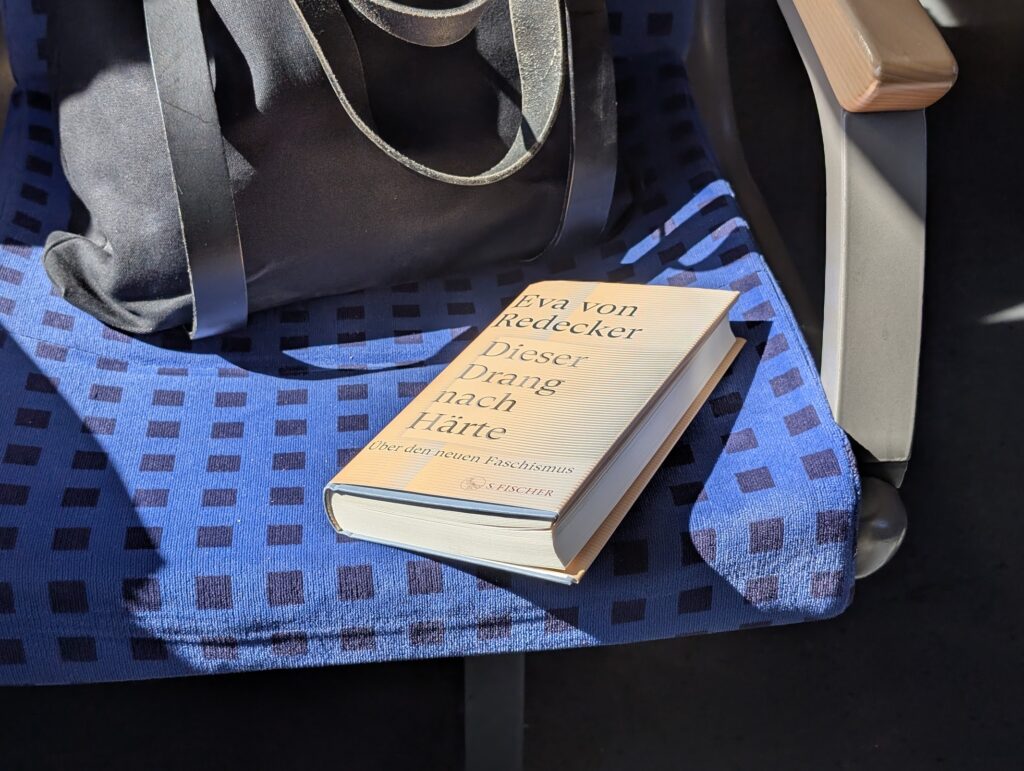
Wo beginnt dieser Weg? Dieser Frage hat sich die Philosophin Eva von Redecker in ihrem neuen Buch „Dieser Drang nach Härte“ gewidmet. Sie beschreibt am Anfang ihres Buches, wie sie auf einem Trödelmarkt in Brandenburg ein altes Blechschild findet. Darauf steht:
„Wer plündert, wird erschossen.“
Dieser Satz, mutmaßlich aus der Zeit von 1933 bis 1945, macht anschaulich, als was von Redecker Faschismus definiert: als „liquidierende Phantombesitzverteidigung“.
Den Kern des Faschismus bilde eine „entfesselte Eigentumslogik“, erklärt die Philosophin. Seine Feinde sind „keine Gegner, sondern Diebe. ‚Die‘, das sind diejenigen, die Quasi-Eigentum angreifen und die deshalb liquidiert gehören.“ (S. 17)
Dieses „Quasi-Eigentum“ kann alles Mögliche sein. Von „der Nation“ über „das völkische Blut“, „die Kinder“ und die „deutsche Sprache“ bis hin zur Meinungsfreiheit. Dem Faschismus geht es dabei „nicht um den Schutz vor echten Gefahren, schon gar nicht vor materiellen Verlusten“, so von Redecker.
„Es geht um den Schutz ‚gegen die‘, die nämlich, denen man das Äußerste zutraut […]. Die, das sind nicht die irgendwie anderen, sondern die abartig anderen. Die Arbeitsscheuen, die Ausländer. Die Schwulen, die Woken […].“ (S. 17)
Die Definition hilft in einem frühen Stadium bei der Analyse. Es müssen nicht erst paramilitärische Gruppen auf den Straßen patrouillieren oder Menschen in Vernichtungslagern landen, damit man den Kern der Gesinnung erkennen kann.
Wenn man „Phantombesitzverteidigung“ betrachtet und das „liquidierend“ weglässt, sieht man, was noch nicht faschistisch ist – aber anschlussfähig. Argumente und Erzählungen, die nicht zwingend zur Vernichtung führen. Eine Verteidigung von „Quasi-Eigentum“, die sich explizit gegen „die“ richtet, die aber noch nicht entfesselt ist und die noch nicht liquidiert.
Wo beginnt dieser Weg? Dieser Frage hat sich die Philosophin Eva von Redecker in ihrem neuen Buch „Dieser Drang nach Härte“ gewidmet. Sie beschreibt am Anfang ihres Buches, wie sie auf einem Trödelmarkt in Brandenburg ein altes Blechschild findet. Darauf steht:
„Wer plündert, wird erschossen.“
Dieser Satz, mutmaßlich aus der Zeit von 1933 bis 1945, macht anschaulich, als was von Redecker Faschismus definiert: als „liquidierende Phantombesitzverteidigung“.
Den Kern des Faschismus bilde eine „entfesselte Eigentumslogik“, erklärt die Philosophin. Seine Feinde sind „keine Gegner, sondern Diebe. ‚Die‘, das sind diejenigen, die Quasi-Eigentum angreifen und die deshalb liquidiert gehören.“ (S. 17)
Dieses „Quasi-Eigentum“ kann alles Mögliche sein. Von „der Nation“ über „das völkische Blut“, „die Kinder“ und die „deutsche Sprache“ bis hin zur Meinungsfreiheit. Dem Faschismus geht es dabei „nicht um den Schutz vor echten Gefahren, schon gar nicht vor materiellen Verlusten“, so von Redecker.
„Es geht um den Schutz ‚gegen die‘, die nämlich, denen man das Äußerste zutraut […]. Die, das sind nicht die irgendwie anderen, sondern die abartig anderen. Die Arbeitsscheuen, die Ausländer. Die Schwulen, die Woken […].“ (S. 17)
Die Definition hilft in einem frühen Stadium bei der Analyse. Es müssen nicht erst paramilitärische Gruppen auf den Straßen patrouillieren oder Menschen in Vernichtungslagern landen, damit man den Kern der Gesinnung erkennen kann.
Wenn man „Phantombesitzverteidigung“ betrachtet und das „liquidierend“ weglässt, sieht man, was noch nicht faschistisch ist – aber anschlussfähig. Argumente und Erzählungen, die nicht zwingend zur Vernichtung führen. Eine Verteidigung von „Quasi-Eigentum“, die sich explizit gegen „die“ richtet, die aber noch nicht entfesselt ist und die noch nicht liquidiert.
In Germany, the question of how a regular neighbour can become a murderer has a historic level, too: because of the mass executions of jewish people, disabled people, (mentally) ill people, homosexual people and other social groups, during the time of National Socialism.
Where does that motion start? That’s a question that philosopher Eva von Redecker is investigating in her new book ”Dieser Drang nach Härte”. At the start of the book, she describes a scene, where she was exploring a flea market in Brandenburg and finds an old metal sign that reads:
”Those who loot, will be shot.”
This sentence/sign, suspected to be made during the nazi regime, shows what von Redecker argues to be fascism at its core: ”the defence of phantom possession to the point of liquidation.”
The core of fascism, according to von Redecker is an ”unleashed logic of possession.” It’s enemies are ”not opponents, but thieves. ‘They’ are those who allegedly threaten property/possessions, and therefore should be liquidated.” (p. 17)
”Alleged possessions” can literally be and mean anything. Either ”the nation”, or ”ethnic blood lines”, ”the children”, or ”the German language,” or even the freedom of speech. Because, as von Redecker writes, fascism ”is not about protection from actual threats, above all not the protection from material losses.”
”It’s all about protecting yourself ‘against the others’, those who you suspect of being capable of anything […]. The others, are not just those who are different, but those who are abnormally different. Those who don’t want to work, those, who come from other countries. The Gays, the Woke People […].” (p. 17)
This definition helps when it comes to recognising and analysing early stages of fascism. This way, fascism can be understood as such, even before paramilitary groups are marching in the streets, or people are sent to concentration camps.
When only looking at ”the defence of phantom possession”, without the ”liquidation” of it all, you might not necessarily define it as fascist, but definitely compatible with the ideology. Arguments and narratives that not necessarily lead to annihilation. But they do defend a ”quasi possession,” against ‘the others’; a defence that isn’t yet unleashed and not yet liquidating.
Where does that motion start? That’s a question that philosopher Eva von Redecker is investigating in her new book ”Dieser Drang nach Härte”. At the start of the book, she describes a scene, where she was exploring a flea market in Brandenburg and finds an old metal sign that reads:
”Those who loot, will be shot.”
This sentence/sign, suspected to be made during the nazi regime, shows what von Redecker argues to be fascism at its core: ”the defence of phantom possession to the point of liquidation.”
The core of fascism, according to von Redecker is an ”unleashed logic of possession.” It’s enemies are ”not opponents, but thieves. ‘They’ are those who allegedly threaten property/possessions, and therefore should be liquidated.” (p. 17)
”Alleged possessions” can literally be and mean anything. Either ”the nation”, or ”ethnic blood lines”, ”the children”, or ”the German language,” or even the freedom of speech. Because, as von Redecker writes, fascism ”is not about protection from actual threats, above all not the protection from material losses.”
”It’s all about protecting yourself ‘against the others’, those who you suspect of being capable of anything […]. The others, are not just those who are different, but those who are abnormally different. Those who don’t want to work, those, who come from other countries. The Gays, the Woke People […].” (p. 17)
This definition helps when it comes to recognising and analysing early stages of fascism. This way, fascism can be understood as such, even before paramilitary groups are marching in the streets, or people are sent to concentration camps.
When only looking at ”the defence of phantom possession”, without the ”liquidation” of it all, you might not necessarily define it as fascist, but definitely compatible with the ideology. Arguments and narratives that not necessarily lead to annihilation. But they do defend a ”quasi possession,” against ‘the others’; a defence that isn’t yet unleashed and not yet liquidating.
III. „Aushöhlen“ und „entwerten“, bis nichts mehr übrig bleibt // ”Undermining” and ”devaluing”, until nothing is left
Explizit nicht faschistisch sind die folgenden Aussagen von Mitgliedern der Bundesregierung. Sie bieten allerdings Anknüpfungspunkte für Faschisten. Denn es sind Aussagen, mit denen Phantombesitz gegen queere Menschen verteidigt werden soll – allerdings ohne ihre Existenz anzugreifen. Aussagen, die eine Erzählung aufbauen, welche andere Kräfte benutzen können, um die Verfolgung und Ermordung von queeren Menschen zu rechtfertigen.
Der erste Schritt ist immer die Abgrenzung von „wir“ gegen „die“. Und diese Abgrenzung kann sehr harmlos daherkommen. „Hähnch*Innen-Filet? Spielplätze für Kinder und Kinderinnen? Wer gibt diesen #Gender-Leuten eigentlich das Recht, einseitig unsere Sprache zu verändern?“, schrieb Merz 2021 im typischen Dieter-Nuhr-Humor auf X (Quelle:https://x.com/_FriedrichMerz/status/1383343760260567043?lang=en ).
„Unsere Sprache“ – das ist hier der Phantombesitz. Der Vorwurf des Diebstahls steckt in der rhetorischen Frage: Niemand gibt „diesen Gender-Leuten“ das Recht, die Sprache zu ändern. Sie nehmen es sich einfach – und die Sprache klauen sie gleich mit. Der heutige Bundesinnenminister Alexander Dobrindt (CSU) grenzte sich 2013 besonders scharf ab: „Die Union als Volkspartei hat die Aufgabe, der stillen Mehrheit eine Stimme zu geben gegen eine schrille Minderheit“, sagte der damalige CSU-Generalsekretär zu Bestrebungen, die Ehe für homosexuelle Beziehungen zu öffnen. (Quelle: https://www.welt.de/politik/deutschland/article114290201/CSU-General-Dobrindt-Union-muss-Stimme-gegen-schrille-Minderheit-sein.html )
Friedrich Merz warf sich verpartnernden Homosexuellen gar vor, den Schutz von Ehe und Familie „auszuhöhlen“ (Quelle: https://www.queer.de/detail.php?article_id=35596). Die heutigeForschungsministerin, Dorothee Bär (CSU), erklärte ebenso, dass die Familie für die Union aus „Vater, Mutter, Kind“ bestehe, alles andere würde die Ehe „aushöhlen„. (Quelle: https://www.queer.de/detail.php?article_id=11799). Aushöhlen – das Wort soll zeigen, dass etwas seines eigentlichen Inhalts beraubt wird und nur noch der äußeren Form nach bestehen bleibt.Dobrindt sagt es mit einem anderen Wort: entwerten. „Es geht darum, dass Ehe und Familie im gesellschaftlichen Diskurs nicht nivelliert und entwertet werden dürfen.“ (Quelle: https://www.welt.de/politik/deutschland/article114290201/CSU-General-Dobrindt-Union-muss-Stimme-gegen-schrille-Minderheit-sein.html )
Die aktuelle Wirtschaftsministerin Katherina Reiche (CDU) dachte in der ARD-Sendung von Günther Jauch 2013 diese angebliche Aushöhlung und Entwertung zu Ende: „Es geht darum, was noch übrigbleibt von Ehe und Familie, wenn homosexuelle Paare bei Ehegattensplitting und Adoptionsrecht die gleichen Rechte bekommen.“ (Quelle: https://www.bild.de/politik/inland/katherina-reiche/mutter-mit-courage-die-cdu-politikerin-kaempft-fuer-die-familie-29377898.bild.html ) Alles ist für Reiche in dieser rhetorischen Frage in Gefahr: Nach der Plünderung der Ehe bleibt nichts mehr von ihr übrig.
Neben der Sprache und der Ehe wird die körperliche Selbstbestimmung als von Schwulen bedrohtes Gut dargestellt. 2001 fragte der „Tagesspiegel“ Friedrich Merz: „Deutschlands Hauptstadt wird von einemSchwulen regiert. Finden Sie das auch so gut wie Bürgermeister Klaus Wowereit?“. Merz antwortete: „Solange er sich mir nicht nähert, ist mir das egal.“ (Quelle: https://www.tagesspiegel.de/berlin/fundsache-857497.html )
Ähnliches wiederholte er laut Wowereit (SPD) vor CDU-Fans in Oberhausen: Er habe nichts gegen die Eingetragene Lebenspartnerschaft, so Merz, „solange ich da nicht mitmachen muss!“ (Quelle: https://mannschaft.com/a/solange-wowereit-sich-mir-nicht-naehert-ist-mir-das-egal )
Eine Interpretation ist, dass hier ein gewaltsamer sexueller Zwang imaginiert wird, der real nicht existiert. Denkbar ist allerdings auch, dass es darum geht, dass ihm die Heterosexualität geraubt wird.
Beide Varianten existieren ebenso, wenn es um Kinder geht. Als Merz 2020 auf seinen homophoben „Witz“ über Wowereit angesprochen wurde, antwortete er: „Die Frage der sexuellen Orientierung gehtdie Öffentlichkeit nichts an. Solange sich das im Rahmen der Gesetze bewegt und solange es nicht Kinder betrifft – an der Stelle ist für mich allerdings eine absolute Grenze erreicht -, ist das kein Thema für die öffentliche Diskussion.“ (Quelle: https://www.queer.de/detail.php?article_id=37118 ).
Die meisten verstanden das so: Merz stelle Schwule unter Pädophilie-Verdacht.
Der Satz lässt sich aber auch umgekehrt verstehen: Kinder sollen von der Frage der sexuellen Orientierung nicht betroffen sein. Sie sollen nicht von der Standardeinstellung abweichen, sollen heterosexuell sein und nicht beeinflusst werden.
“It’s like it creeps through the walls. You and your thoughts”, sagt Clive, der mutmaßliche Täter in “Tip Toe” zu Leo, nachdem sich herausgestellt hat, dass Clives Sohn, George, ebenfalls schwul ist. “I sleep ten feet way and I infect George?!”, antwortet Leo. “You sleep two feet way. Why don’t you infect him, why isn’t he stupid and straight like you?”
Er habe keine Chance, antwortet Clive. Schwule seien jeden Abend im Fernsehen. „You’re watching something and two minutes later it’s men kissing.“
Dass hier Kinder – genauer gesagt: scheinbar heterosexuelle Kinder – als Phantombesitz dienen, wird in Tip Toe deutlich, als Clive wütend protestiert: “He lives under my roof!” Wenn die eigenen Kinderals queer geoutet sind, ist es für einige Eltern so, als hätte man sie ihnen gestohlen.
“They make a link between gay men and children- And that link is ineradicable, it cannot be removed”, sagt Melba später in der Serie. “And they know that, the bastards. So they repeat it, they shout it, over and over and louder and louder.”
Stehen heterosexuelle Kinder auf dem Spiel, steht alles auf dem Spiel. Ohne Familie mit Kindern gebe es „keine Zukunft“ für Deutschland. „Unsere Zukunft liegt in der Hand der Familien, nicht in gleichgeschlechtlichen Lebensgemeinschaften“, sagte Katherina Reiche 2012.
Sie fürchtet offenbar, dass queere Menschen den Wohlstand verschwinden lassen: „Neben der Euro-Krise ist die demografische Entwicklung die größte Bedrohung unseres Wohlstands.“ (Quelle: https://m.bild.de/politik/inland/gleichgeschlechtliche-ehe/cdu-reiche-kaempft-fuer-ehe-25746958.bildMobile.html?t_ref=https%3A%2F%2Fwww.queer.de%2Fdetail.php%3Farticle_id%3D17212)
Und nicht nur das: Auf die Frage eines Nutzers von Abgeordnetenwatch, inwiefern die Zukunft durch eine Homo-Ehe „beeinträchtigt“ würde, antwortete sie: „Falls Ihre (…) Frage überhaupt Relevanzbesitzen sollte, dann entwickelt sich eine Gesellschaft in die Strukturlosigkeit, die am Ende ausschließlich materiellen Anreizen folgt. Auf der einen Seite unbegrenzter Hedonismus, auf der anderenunendliches Leid.“ (Quelle: https://www.queer.de/detail.php?article_id=20090 )
Geplündert wird also in diesem Bild: die Sprache. Die Familie. Der Wohlstand. Die Zukunft.
Welche Taten lassen sich durch so eine Rhetorik rechtfertigen? Ist es nicht die Pflicht jedes einzelnen, aktiv zu werden, wenn „unendliches Leid“ droht? Zu welchen Taten können sich Menschen inspiriert fühlen, die einen solchen Raubzug fürchten?
Der erste Schritt ist immer die Abgrenzung von „wir“ gegen „die“. Und diese Abgrenzung kann sehr harmlos daherkommen. „Hähnch*Innen-Filet? Spielplätze für Kinder und Kinderinnen? Wer gibt diesen #Gender-Leuten eigentlich das Recht, einseitig unsere Sprache zu verändern?“, schrieb Merz 2021 im typischen Dieter-Nuhr-Humor auf X (Quelle:https://x.com/_FriedrichMerz/status/1383343760260567043?lang=en ).
„Unsere Sprache“ – das ist hier der Phantombesitz. Der Vorwurf des Diebstahls steckt in der rhetorischen Frage: Niemand gibt „diesen Gender-Leuten“ das Recht, die Sprache zu ändern. Sie nehmen es sich einfach – und die Sprache klauen sie gleich mit. Der heutige Bundesinnenminister Alexander Dobrindt (CSU) grenzte sich 2013 besonders scharf ab: „Die Union als Volkspartei hat die Aufgabe, der stillen Mehrheit eine Stimme zu geben gegen eine schrille Minderheit“, sagte der damalige CSU-Generalsekretär zu Bestrebungen, die Ehe für homosexuelle Beziehungen zu öffnen. (Quelle: https://www.welt.de/politik/deutschland/article114290201/CSU-General-Dobrindt-Union-muss-Stimme-gegen-schrille-Minderheit-sein.html )
Friedrich Merz warf sich verpartnernden Homosexuellen gar vor, den Schutz von Ehe und Familie „auszuhöhlen“ (Quelle: https://www.queer.de/detail.php?article_id=35596). Die heutigeForschungsministerin, Dorothee Bär (CSU), erklärte ebenso, dass die Familie für die Union aus „Vater, Mutter, Kind“ bestehe, alles andere würde die Ehe „aushöhlen„. (Quelle: https://www.queer.de/detail.php?article_id=11799). Aushöhlen – das Wort soll zeigen, dass etwas seines eigentlichen Inhalts beraubt wird und nur noch der äußeren Form nach bestehen bleibt.Dobrindt sagt es mit einem anderen Wort: entwerten. „Es geht darum, dass Ehe und Familie im gesellschaftlichen Diskurs nicht nivelliert und entwertet werden dürfen.“ (Quelle: https://www.welt.de/politik/deutschland/article114290201/CSU-General-Dobrindt-Union-muss-Stimme-gegen-schrille-Minderheit-sein.html )
Die aktuelle Wirtschaftsministerin Katherina Reiche (CDU) dachte in der ARD-Sendung von Günther Jauch 2013 diese angebliche Aushöhlung und Entwertung zu Ende: „Es geht darum, was noch übrigbleibt von Ehe und Familie, wenn homosexuelle Paare bei Ehegattensplitting und Adoptionsrecht die gleichen Rechte bekommen.“ (Quelle: https://www.bild.de/politik/inland/katherina-reiche/mutter-mit-courage-die-cdu-politikerin-kaempft-fuer-die-familie-29377898.bild.html ) Alles ist für Reiche in dieser rhetorischen Frage in Gefahr: Nach der Plünderung der Ehe bleibt nichts mehr von ihr übrig.
Neben der Sprache und der Ehe wird die körperliche Selbstbestimmung als von Schwulen bedrohtes Gut dargestellt. 2001 fragte der „Tagesspiegel“ Friedrich Merz: „Deutschlands Hauptstadt wird von einemSchwulen regiert. Finden Sie das auch so gut wie Bürgermeister Klaus Wowereit?“. Merz antwortete: „Solange er sich mir nicht nähert, ist mir das egal.“ (Quelle: https://www.tagesspiegel.de/berlin/fundsache-857497.html )
Ähnliches wiederholte er laut Wowereit (SPD) vor CDU-Fans in Oberhausen: Er habe nichts gegen die Eingetragene Lebenspartnerschaft, so Merz, „solange ich da nicht mitmachen muss!“ (Quelle: https://mannschaft.com/a/solange-wowereit-sich-mir-nicht-naehert-ist-mir-das-egal )
Eine Interpretation ist, dass hier ein gewaltsamer sexueller Zwang imaginiert wird, der real nicht existiert. Denkbar ist allerdings auch, dass es darum geht, dass ihm die Heterosexualität geraubt wird.
Beide Varianten existieren ebenso, wenn es um Kinder geht. Als Merz 2020 auf seinen homophoben „Witz“ über Wowereit angesprochen wurde, antwortete er: „Die Frage der sexuellen Orientierung gehtdie Öffentlichkeit nichts an. Solange sich das im Rahmen der Gesetze bewegt und solange es nicht Kinder betrifft – an der Stelle ist für mich allerdings eine absolute Grenze erreicht -, ist das kein Thema für die öffentliche Diskussion.“ (Quelle: https://www.queer.de/detail.php?article_id=37118 ).
Die meisten verstanden das so: Merz stelle Schwule unter Pädophilie-Verdacht.
Der Satz lässt sich aber auch umgekehrt verstehen: Kinder sollen von der Frage der sexuellen Orientierung nicht betroffen sein. Sie sollen nicht von der Standardeinstellung abweichen, sollen heterosexuell sein und nicht beeinflusst werden.
“It’s like it creeps through the walls. You and your thoughts”, sagt Clive, der mutmaßliche Täter in “Tip Toe” zu Leo, nachdem sich herausgestellt hat, dass Clives Sohn, George, ebenfalls schwul ist. “I sleep ten feet way and I infect George?!”, antwortet Leo. “You sleep two feet way. Why don’t you infect him, why isn’t he stupid and straight like you?”
Er habe keine Chance, antwortet Clive. Schwule seien jeden Abend im Fernsehen. „You’re watching something and two minutes later it’s men kissing.“
Dass hier Kinder – genauer gesagt: scheinbar heterosexuelle Kinder – als Phantombesitz dienen, wird in Tip Toe deutlich, als Clive wütend protestiert: “He lives under my roof!” Wenn die eigenen Kinderals queer geoutet sind, ist es für einige Eltern so, als hätte man sie ihnen gestohlen.
“They make a link between gay men and children- And that link is ineradicable, it cannot be removed”, sagt Melba später in der Serie. “And they know that, the bastards. So they repeat it, they shout it, over and over and louder and louder.”
Stehen heterosexuelle Kinder auf dem Spiel, steht alles auf dem Spiel. Ohne Familie mit Kindern gebe es „keine Zukunft“ für Deutschland. „Unsere Zukunft liegt in der Hand der Familien, nicht in gleichgeschlechtlichen Lebensgemeinschaften“, sagte Katherina Reiche 2012.
Sie fürchtet offenbar, dass queere Menschen den Wohlstand verschwinden lassen: „Neben der Euro-Krise ist die demografische Entwicklung die größte Bedrohung unseres Wohlstands.“ (Quelle: https://m.bild.de/politik/inland/gleichgeschlechtliche-ehe/cdu-reiche-kaempft-fuer-ehe-25746958.bildMobile.html?t_ref=https%3A%2F%2Fwww.queer.de%2Fdetail.php%3Farticle_id%3D17212)
Und nicht nur das: Auf die Frage eines Nutzers von Abgeordnetenwatch, inwiefern die Zukunft durch eine Homo-Ehe „beeinträchtigt“ würde, antwortete sie: „Falls Ihre (…) Frage überhaupt Relevanzbesitzen sollte, dann entwickelt sich eine Gesellschaft in die Strukturlosigkeit, die am Ende ausschließlich materiellen Anreizen folgt. Auf der einen Seite unbegrenzter Hedonismus, auf der anderenunendliches Leid.“ (Quelle: https://www.queer.de/detail.php?article_id=20090 )
Geplündert wird also in diesem Bild: die Sprache. Die Familie. Der Wohlstand. Die Zukunft.
Welche Taten lassen sich durch so eine Rhetorik rechtfertigen? Ist es nicht die Pflicht jedes einzelnen, aktiv zu werden, wenn „unendliches Leid“ droht? Zu welchen Taten können sich Menschen inspiriert fühlen, die einen solchen Raubzug fürchten?
The following statements by members of German parliament are specifically not fascist. They do however remain very compatible with explicit fascist narratives. They are statements that apparently seem to defend ”phantom possessions” against queer people — without actually coming for the existence of the latter. Statements that can be used by other forces to justify the persecution and murder of queer people.
The first step is always separating a ”we” from ”them”. This separation can look very innocent. ”chick*hen filet? Playgrounds for children of unspecified gender? Who has given those #gender-folks the right to change our language?”, Friedlich Merz (the German chancellor) posted on X in 2021, in typical Dieter-Nuhr-fashion.
“Our language” – that is the phantom possession at stake here. The accusation of theft is embedded in the rhetorical question: nobody is giving “these gender people” the right to change the language.
They simply take it for themselves – and steal the language along with it. In 2013 the current Federal Minister of the Interior, Alexander Dobrindt (CSU), distanced himself particularly sharply: “The Union, as a people’s party, has a duty to give the silent majority a voice against a shrill minority,” said the then CSU Secretary-General, referring to efforts to open up marriage to same-sex relationships. (Source: https://www.welt.de/politik/deutschland/article114290201/CSU-General-Dobrindt-Union-muss-Stimme-gegen-schrille-Minderheit-sein.html )
Friedrich Merz even accused homosexuals entering civil partnerships of gutting the protection of marriage and family. (Source: https://www.queer.de/detail.php?article_id=35596). The current Minister for Research, Dorothee Bär (CSU), likewise stated that, for the Union, the family consists of “father, mother and child”; anything else would “undermine” marriage. (Source: https://www.queer.de/detail.php?article_id=11799). ‘Erode’ – the word is intended to show that something is being stripped of its actual substance and only retains its outward form. Dobrindt puts it another way: devalue. “The point is that marriage and the family must not be trivialised and devalued in public discourse.” (Source: https://www.welt.de/politik/deutschland/article114290201/CSU-General-Dobrindt-Union-muss-Stimme-gegen-schrille-Minderheit-sein.html )
The current Minister for Economic Affairs, Katherina Reiche (CDU), took this alleged erosion and devaluation to its logical conclusion on Günther Jauch’s ARD programme in 2013: “The question is what will remain of marriage and the family if same-sex couples are granted the same rights to joint taxation and adoption.” (Source: https://www.bild.de/politik/inland/katherina-reiche/mutter-mit-courage-die-cdu-politikerin-kaempft-fuer-die-familie-29377898.bild.html ) For Reiche, everything is at risk in this rhetorical question: once marriage has been plundered, nothing will remain of it.
Alongside language and marriage, physical autonomy is portrayed as a value threatened by gay men.
In 2001, the *Tagesspiegel* asked Friedrich Merz: “Germany’s capital is governed by a gay man. Do you think that’s as good a thing as Mayor Klaus Wowereit does?” Merz replied: “As long as he doesn’t come near me, I don’t care.” (Source: https://www.tagesspiegel.de/berlin/fundsache-857497.html )
According to Wowereit (SPD), he repeated similar remarks to CDU supporters in Oberhausen: he had nothing against registered civil partnerships, Merz said, “as long as I don’t have to take part in them!” (Source: https://mannschaft.com/a/solange-wowereit-sich-mir-nicht-naehert-ist-mir-das-egal )
One interpretation is that this imagines a form of violent sexual coercion that does not actually exist. It is also conceivable, however, that the issue is that he is being robbed of his heterosexuality.
Both approaches apply equally when it comes to children. When Merz was asked in 2020 about his homophobic ‘joke’ about Wowereit, he replied: “The question of sexual orientation is none of the public’s business. As long as it remains within the bounds of the law and as long as it does not involve children – although for me, that is where an absolute line is drawn – it is not a matter for public debate.” (Source: https://www.queer.de/detail.php?article_id=37118 ).
Most people interpreted this to mean that Merz was casting suspicion on gay men as paedophiles.
However, the statement can also be understood the other way round: children should not be affected by the issue of sexual orientation. They should not deviate from the norm, should be heterosexual and should not be influenced.
“It’s like it creeps through the walls. You and your thoughts,” says Clive, the alleged perpetrator in *Tip Toe*, to Leo, after it has emerged that Clive’s son, George, is also gay. “I sleep ten feet away and I infect George?!” replies Leo. “You sleep two feet away. Why don’t you infect him? Why isn’t he stupid and straight like you?”
He doesn’t stand a chance, replies Clive. Gay men are on the telly every evening. “You’re watching something and two minutes later it’s men kissing.”
The fact that children here – or, to be more precise, apparently heterosexual children – serve as a phantom possession becomes clear in *Tip Toe* when Clive protests furiously: “He lives under my roof!” When their own children come out as queer, for some parents it feels as though they have been stolen from them.
“They make a link between gay men and children – and that link is ineradicable, it cannot be removed,” says Melba later in the series. “And they know that, the bastards. So they repeat it, they shout it, over and over and louder and louder.”
When heterosexual children are at stake, everything is at stake. Without families with children, there is “no future” for Germany. “Our future lies in the hands of families, not in same-sex partnerships,” said Katherina Reiche in 2012.
She apparently fears that queer people will cause prosperity to disappear: “Alongside the euro crisis, demographic trends are the greatest threat to our prosperity.” (Source: https://m.bild.de/politik/inland/gleichgeschlechtliche-ehe/cdu-reiche-kaempft-fuer-ehe-25746958.bildMobile.htmlt_ref=https%3A%2F%2Fwww.queer.de%2Fdetail.php%3Farticle_id%3D17212)
And that’s not all: in response to a question from a user of Abgeordnetenwatch asking to what extent the future would be ‘undermined’ by same-sex marriage, she replied: ‘If your (…) question were to have any relevance at all, then society would descend into a state of structural chaos, ultimately following nothing but material incentives. On the one hand, boundless hedonism; on the other, endless suffering.” (Source: https://www.queer.de/detail.php?article_id=20090 )
So, in this picture, the following are being plundered: language. The family. Prosperity. The future.
What actions can be justified by such rhetoric? Is it not the duty of every individual to take action when ‘endless suffering’ looms? What actions might people who fear such a plunder be inspired to take?
The first step is always separating a ”we” from ”them”. This separation can look very innocent. ”chick*hen filet? Playgrounds for children of unspecified gender? Who has given those #gender-folks the right to change our language?”, Friedlich Merz (the German chancellor) posted on X in 2021, in typical Dieter-Nuhr-fashion.
“Our language” – that is the phantom possession at stake here. The accusation of theft is embedded in the rhetorical question: nobody is giving “these gender people” the right to change the language.
They simply take it for themselves – and steal the language along with it. In 2013 the current Federal Minister of the Interior, Alexander Dobrindt (CSU), distanced himself particularly sharply: “The Union, as a people’s party, has a duty to give the silent majority a voice against a shrill minority,” said the then CSU Secretary-General, referring to efforts to open up marriage to same-sex relationships. (Source: https://www.welt.de/politik/deutschland/article114290201/CSU-General-Dobrindt-Union-muss-Stimme-gegen-schrille-Minderheit-sein.html )
Friedrich Merz even accused homosexuals entering civil partnerships of gutting the protection of marriage and family. (Source: https://www.queer.de/detail.php?article_id=35596). The current Minister for Research, Dorothee Bär (CSU), likewise stated that, for the Union, the family consists of “father, mother and child”; anything else would “undermine” marriage. (Source: https://www.queer.de/detail.php?article_id=11799). ‘Erode’ – the word is intended to show that something is being stripped of its actual substance and only retains its outward form. Dobrindt puts it another way: devalue. “The point is that marriage and the family must not be trivialised and devalued in public discourse.” (Source: https://www.welt.de/politik/deutschland/article114290201/CSU-General-Dobrindt-Union-muss-Stimme-gegen-schrille-Minderheit-sein.html )
The current Minister for Economic Affairs, Katherina Reiche (CDU), took this alleged erosion and devaluation to its logical conclusion on Günther Jauch’s ARD programme in 2013: “The question is what will remain of marriage and the family if same-sex couples are granted the same rights to joint taxation and adoption.” (Source: https://www.bild.de/politik/inland/katherina-reiche/mutter-mit-courage-die-cdu-politikerin-kaempft-fuer-die-familie-29377898.bild.html ) For Reiche, everything is at risk in this rhetorical question: once marriage has been plundered, nothing will remain of it.
Alongside language and marriage, physical autonomy is portrayed as a value threatened by gay men.
In 2001, the *Tagesspiegel* asked Friedrich Merz: “Germany’s capital is governed by a gay man. Do you think that’s as good a thing as Mayor Klaus Wowereit does?” Merz replied: “As long as he doesn’t come near me, I don’t care.” (Source: https://www.tagesspiegel.de/berlin/fundsache-857497.html )
According to Wowereit (SPD), he repeated similar remarks to CDU supporters in Oberhausen: he had nothing against registered civil partnerships, Merz said, “as long as I don’t have to take part in them!” (Source: https://mannschaft.com/a/solange-wowereit-sich-mir-nicht-naehert-ist-mir-das-egal )
One interpretation is that this imagines a form of violent sexual coercion that does not actually exist. It is also conceivable, however, that the issue is that he is being robbed of his heterosexuality.
Both approaches apply equally when it comes to children. When Merz was asked in 2020 about his homophobic ‘joke’ about Wowereit, he replied: “The question of sexual orientation is none of the public’s business. As long as it remains within the bounds of the law and as long as it does not involve children – although for me, that is where an absolute line is drawn – it is not a matter for public debate.” (Source: https://www.queer.de/detail.php?article_id=37118 ).
Most people interpreted this to mean that Merz was casting suspicion on gay men as paedophiles.
However, the statement can also be understood the other way round: children should not be affected by the issue of sexual orientation. They should not deviate from the norm, should be heterosexual and should not be influenced.
“It’s like it creeps through the walls. You and your thoughts,” says Clive, the alleged perpetrator in *Tip Toe*, to Leo, after it has emerged that Clive’s son, George, is also gay. “I sleep ten feet away and I infect George?!” replies Leo. “You sleep two feet away. Why don’t you infect him? Why isn’t he stupid and straight like you?”
He doesn’t stand a chance, replies Clive. Gay men are on the telly every evening. “You’re watching something and two minutes later it’s men kissing.”
The fact that children here – or, to be more precise, apparently heterosexual children – serve as a phantom possession becomes clear in *Tip Toe* when Clive protests furiously: “He lives under my roof!” When their own children come out as queer, for some parents it feels as though they have been stolen from them.
“They make a link between gay men and children – and that link is ineradicable, it cannot be removed,” says Melba later in the series. “And they know that, the bastards. So they repeat it, they shout it, over and over and louder and louder.”
When heterosexual children are at stake, everything is at stake. Without families with children, there is “no future” for Germany. “Our future lies in the hands of families, not in same-sex partnerships,” said Katherina Reiche in 2012.
She apparently fears that queer people will cause prosperity to disappear: “Alongside the euro crisis, demographic trends are the greatest threat to our prosperity.” (Source: https://m.bild.de/politik/inland/gleichgeschlechtliche-ehe/cdu-reiche-kaempft-fuer-ehe-25746958.bildMobile.htmlt_ref=https%3A%2F%2Fwww.queer.de%2Fdetail.php%3Farticle_id%3D17212)
And that’s not all: in response to a question from a user of Abgeordnetenwatch asking to what extent the future would be ‘undermined’ by same-sex marriage, she replied: ‘If your (…) question were to have any relevance at all, then society would descend into a state of structural chaos, ultimately following nothing but material incentives. On the one hand, boundless hedonism; on the other, endless suffering.” (Source: https://www.queer.de/detail.php?article_id=20090 )
So, in this picture, the following are being plundered: language. The family. Prosperity. The future.
What actions can be justified by such rhetoric? Is it not the duty of every individual to take action when ‘endless suffering’ looms? What actions might people who fear such a plunder be inspired to take?
IV. „Unsere Gesellschaft“ // „Our Society“
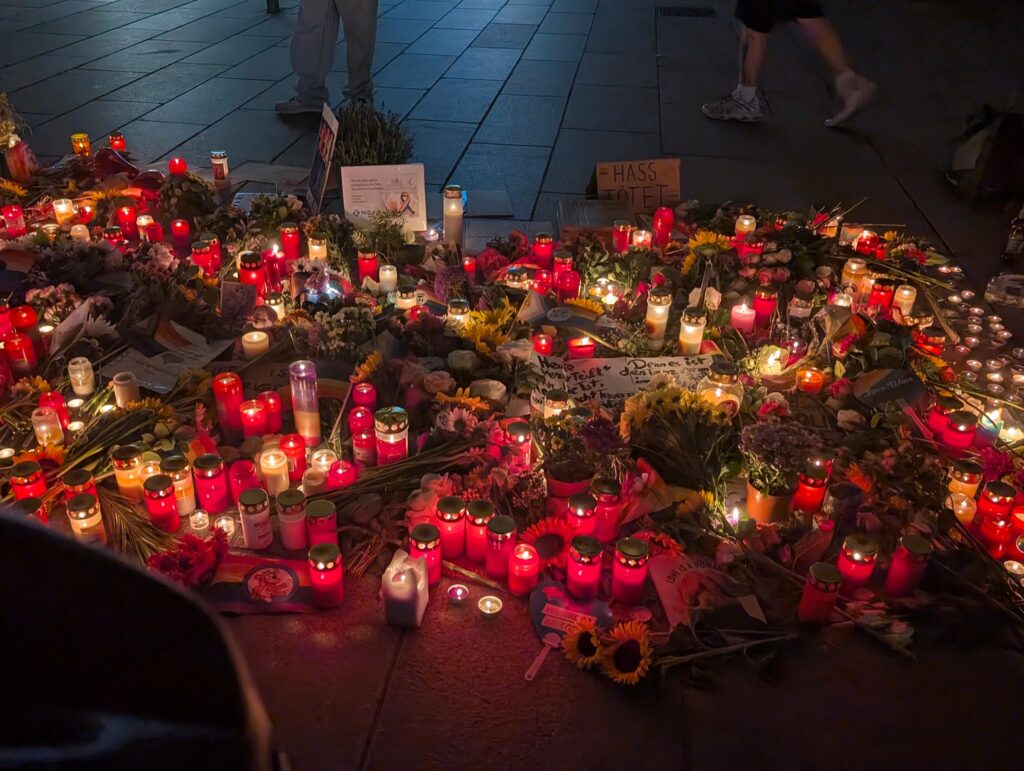
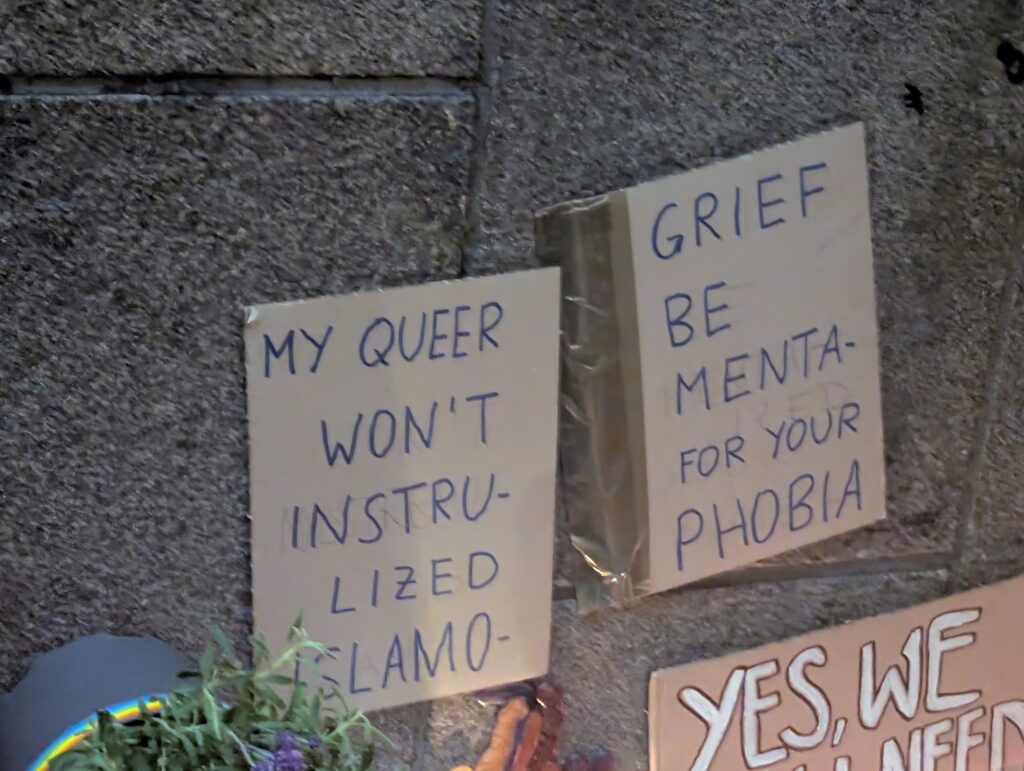
Dieser Text war nahezu fertig – und dann, am 25. Juli, fuhr ein Attentäter mit einem Kleinbus in eine Menschenmenge beim Christopher-Street-Day in Berlin. Er ermordete dabei eine polnische Frau und verletzte 16 weitere Menschen teils schwer. Nur wenige Schritte vom Denkmal für die im Nationalsozialismus verfolgten Homosexuellen entfernt. Als ich von dem Attentat gehört habe, war mein erster Gedanke:
Es war nur eine Frage der Zeit, dass so etwas passiert. Terror braucht keine Zelle mehr. Zum Standard ist stochastischer Terrorismus geworden:
Wenn genug Menschen so lange radikalisiert werden, wird irgendjemand von ihnen irgendwo selbstständig zum Täter. Diese Radikalisierung ist heute unübersehbar.
Dieser Text kann die Ideologie des mutmaßlichen islamistischen Attentäters nicht erklären. Rechtsextremismus und Islamismus sind zwei verschiedene Phänomene – die sich allerdings gegenseitig verstärken, die beide queeres Leben gefährden und deshalb beide ernst genommen werden müssen.
Dieser Text kann allerdings aufzeigen, warum die Regierungs-Reaktion auf das Attentat so verletzend ist. Denn die Regierungsmitglieder, die nach dem Anschlag ans Mikrofon traten, reden seit zwanzig Jahren so, wie sie eben geredet haben.
Nach dem Terroranschlag auf zwei Moscheen in Christchurch gingen von der neuseeländischen Premierministerin Jacinda Ardern Bilder um die Welt, in denen sie mit Kopfbedeckung Mitglieder der angegriffenen Community umarmt und ihre Trauer teilt. Von unserem Bundeskanzler gab es solche Bilder nicht und ich würde so weit gehen zu sagen: Sie wären undenkbar.
Merz bezeichnete die Attackierten zunächst als „friedlich feiernde Menschen“, und unterschlug, dass es queere Menschen waren. Dass es protestierende Menschen waren – protestierend gegen seine Politik. Er, der sich in der Vergangenheit immer von „Gender-Leuten“ abgrenzte und wiederholt darauf bestand, dass sie ihm und den Kindern nicht zu nahe kommen, spricht von einem „Angriff auf unsere Gesellschaft“.
Fast 24 Stunden dauerte es, bis sich der Kanzler an die queere Community richtete.
Er tat das mit der Anrede „Meine Damen und Herren“ – also explizit einen großen Teil der Community ausblendend – in einer Kirche, einem Ort, an dem sich ein Großteil der Community nicht akzeptiert fühlt. Dem Vorschlag, Merz könne doch als Zeichen der Solidarität eine Woche später zum CSD nach Hamburg kommen, kam er nicht nach, sondern kündigte stattdessen seinen Urlaub an.
Dass ein Anschlag auf die queere Community von der Bundesregierung nicht als solcher behandelt werden muss, wird dadurch möglich gemacht, indem man lediglich von einem „islamistischen Anschlag“ spricht. Obwohl es natürlich beides ist: ein islamistischer queerfeindlicher Anschlag.
Die Abgrenzung von „denen“ bleibt intakt: „Wir alle“ wurden angegriffen, aber nicht „die“.
Es war nur eine Frage der Zeit, dass so etwas passiert. Terror braucht keine Zelle mehr. Zum Standard ist stochastischer Terrorismus geworden:
Wenn genug Menschen so lange radikalisiert werden, wird irgendjemand von ihnen irgendwo selbstständig zum Täter. Diese Radikalisierung ist heute unübersehbar.
Dieser Text kann die Ideologie des mutmaßlichen islamistischen Attentäters nicht erklären. Rechtsextremismus und Islamismus sind zwei verschiedene Phänomene – die sich allerdings gegenseitig verstärken, die beide queeres Leben gefährden und deshalb beide ernst genommen werden müssen.
Dieser Text kann allerdings aufzeigen, warum die Regierungs-Reaktion auf das Attentat so verletzend ist. Denn die Regierungsmitglieder, die nach dem Anschlag ans Mikrofon traten, reden seit zwanzig Jahren so, wie sie eben geredet haben.
Nach dem Terroranschlag auf zwei Moscheen in Christchurch gingen von der neuseeländischen Premierministerin Jacinda Ardern Bilder um die Welt, in denen sie mit Kopfbedeckung Mitglieder der angegriffenen Community umarmt und ihre Trauer teilt. Von unserem Bundeskanzler gab es solche Bilder nicht und ich würde so weit gehen zu sagen: Sie wären undenkbar.
Merz bezeichnete die Attackierten zunächst als „friedlich feiernde Menschen“, und unterschlug, dass es queere Menschen waren. Dass es protestierende Menschen waren – protestierend gegen seine Politik. Er, der sich in der Vergangenheit immer von „Gender-Leuten“ abgrenzte und wiederholt darauf bestand, dass sie ihm und den Kindern nicht zu nahe kommen, spricht von einem „Angriff auf unsere Gesellschaft“.
Fast 24 Stunden dauerte es, bis sich der Kanzler an die queere Community richtete.
Er tat das mit der Anrede „Meine Damen und Herren“ – also explizit einen großen Teil der Community ausblendend – in einer Kirche, einem Ort, an dem sich ein Großteil der Community nicht akzeptiert fühlt. Dem Vorschlag, Merz könne doch als Zeichen der Solidarität eine Woche später zum CSD nach Hamburg kommen, kam er nicht nach, sondern kündigte stattdessen seinen Urlaub an.
Dass ein Anschlag auf die queere Community von der Bundesregierung nicht als solcher behandelt werden muss, wird dadurch möglich gemacht, indem man lediglich von einem „islamistischen Anschlag“ spricht. Obwohl es natürlich beides ist: ein islamistischer queerfeindlicher Anschlag.
Die Abgrenzung von „denen“ bleibt intakt: „Wir alle“ wurden angegriffen, aber nicht „die“.
This text was almost finished – and then, on 25 July, an attacker drove a minibus into a crowd at Christopher Street Day in Berlin. In the attack, he murdered a Polish woman and injured 16 other people, some seriously. Just a few steps away from the memorial to homosexuals persecuted under National Socialism. When I heard about the attack, my first thought was:
It was only a matter of time before something like this happened. Terrorism no longer needs a cell. Stochastic terrorism has become the norm:
If enough people are radicalised for long enough, one of them, somewhere, will act independently as a perpetrator. This radicalisation is impossible to overlook today.
This text cannot explain the ideology of the alleged Islamist attacker. Far-right extremism and Islamism are two distinct phenomena – though they reinforce one another, both endanger queer lives and must therefore both be taken seriously.
However, this text may help to explain why the government’s response to the attack is so hurtful. For the government ministers who took to the microphone after the attack have been speaking in exactly the same way for the past twenty years.
Following the terrorist attack on two mosques in Christchurch, images from New Zealand’s Prime Minister Jacinda Ardern were broadcast around the world, showing her, wearing a headscarf, embracing members of the attacked community and sharing their grief. There were no such images of our Chancellor, and I would go so far as to say: they would be unthinkable.
Merz initially described those attacked as “people celebrating peacefully”, and failed to mention that they were queer people. That they were people protesting – protesting against his policies. He, who in the past has always distanced himself from ‘gender activists’ and repeatedly insisted that they should not get too close to him or to children, speaks of an ‘attack on our society’.
It took almost 24 hours for the Chancellor to address the queer community.
He did so by addressing them as “Ladies and gentlemen” – thus explicitly excluding a large part of the community – in a church, a place where a large proportion of the community does not feel accepted. He did not take up the suggestion that Merz could, as a sign of solidarity, come to Hamburg a week later for the CSD, but instead announced his holiday.
The fact that an attack on the queer community does not have to be treated as such by the federal government is made possible simply by referring to it as an ‘Islamist attack’. Although, of course, it is both: an Islamist attack directed against the queer community.
The distinction from ‘them’ remains intact: ‘We all’ were attacked, but not ‘them’.
It was only a matter of time before something like this happened. Terrorism no longer needs a cell. Stochastic terrorism has become the norm:
If enough people are radicalised for long enough, one of them, somewhere, will act independently as a perpetrator. This radicalisation is impossible to overlook today.
This text cannot explain the ideology of the alleged Islamist attacker. Far-right extremism and Islamism are two distinct phenomena – though they reinforce one another, both endanger queer lives and must therefore both be taken seriously.
However, this text may help to explain why the government’s response to the attack is so hurtful. For the government ministers who took to the microphone after the attack have been speaking in exactly the same way for the past twenty years.
Following the terrorist attack on two mosques in Christchurch, images from New Zealand’s Prime Minister Jacinda Ardern were broadcast around the world, showing her, wearing a headscarf, embracing members of the attacked community and sharing their grief. There were no such images of our Chancellor, and I would go so far as to say: they would be unthinkable.
Merz initially described those attacked as “people celebrating peacefully”, and failed to mention that they were queer people. That they were people protesting – protesting against his policies. He, who in the past has always distanced himself from ‘gender activists’ and repeatedly insisted that they should not get too close to him or to children, speaks of an ‘attack on our society’.
It took almost 24 hours for the Chancellor to address the queer community.
He did so by addressing them as “Ladies and gentlemen” – thus explicitly excluding a large part of the community – in a church, a place where a large proportion of the community does not feel accepted. He did not take up the suggestion that Merz could, as a sign of solidarity, come to Hamburg a week later for the CSD, but instead announced his holiday.
The fact that an attack on the queer community does not have to be treated as such by the federal government is made possible simply by referring to it as an ‘Islamist attack’. Although, of course, it is both: an Islamist attack directed against the queer community.
The distinction from ‘them’ remains intact: ‘We all’ were attacked, but not ‘them’.
So kann Bundestagspräsidentin Julia Klöckner (CDU) die Deutschlandfahne auf halbmast hissen, aber die Regenbogenfahne am Reichstagsgebäude gilt ihr weiter als Tabu, das den Bundestag nach den Worten des Kanzlers zum „Zirkuszelt“ abwerten würde. Und die Forderung, dass die queere Community wie andere NS-Opfergruppen in Artikel 3 des Grundgesetzes geschützt werden soll, kann Unionsfraktionschef Thorsten Frei (CDU) als einen „symbolischen Schritt“ abtun, der die Verfassung „überfrachten“ würde. Danke für nichts.
Einer ähnlichen Logik folgt die Ankündigung von Familienministerin Karin Prien (CDU), fünf Millionen Euro in Deradikalisierungsprogramme zu stecken. Das Geld soll aus dem Topf „Demokratie leben“ genommen werden und damit „uns alle“ schützen. Aber das Geld muss dafür an anderer Stelle, also bei „denen“ eingespart werden. Vielfalt sei kein staatliches Förderziel, argumentiert Prien – und streicht das Geld für einen queeren Jugendverband, der suizidgefährdeten Jugendlichen hilft. „Unsere“ Toten werden indirekt gegen „deren“ Tote ausgespielt.
Nachdem Unionspolitiker der AfD mit obigen Aussagen zu queeren Menschen Anknüpfungspunkte für eine weitere Eskalation geboten haben, könnten die Maßnahmen, die CDU und CSU nach dem Anschlag nun fordern, von zukünftigen AfD-Regierungen gegen Schwule, Lesben, Bisexuelle, trans- und intergeschlechtliche Menschen eingesetzt werden.
Besonders geschichtsvergessen ist der Ruf nach „Präventivgewahrsam“ – also eine Strafe ohne vorherige Tat. Am 12. Juli 1940 hieß diese Maßnahme noch „polizeiliche Vorbeugehaft“ und wurde von Heinrich Himmler gegen Homosexuelle verhängt. Damit begannen die Nationalsozialisten, 10.000 bis 15.000 homosexuelle Männer in Konzentrationslager zu stecken und die Mehrheit von ihnen zu ermorden.
Der Bundeskanzler will nun sogenannte „Gefährder“ ausbürgern – also Menschen, die von Behörden so eingestuft werden können, auch wenn sie noch gar keine Straftaten begangen haben. Damit spielt er der AfD in die Hände, deren Stimmenanteil bei Landtagswahlen laut einer Studie Frankfurter Wissenschaftler nach erfolgreichen Anschlägen um 4,5 Prozentpunkte steigt (Quelle: https://www.uni-frankfurt.de/de/newsroom/meldungen/webexklusiv/wie-sich-terroranschlaege-auf-den-wahlerfolg-der-afd-auswirken ). Er verleiht der Partei Legitimität, indem er eine Forderung von ihr übernimmt, die in Gutachten zentral für die Verfassungswidrigkeit der AfD angeführt wird (Quelle: https://afd-gutachten.de/ ). Merz erschwert es damit, ein Verbotsverfahren gegen diese queerfeindliche Partei gut begründet zu starten, und er belastet einen zentralen Argumentationsstrang für ein Verfahren vor dem Bundesverfassungsgericht.
In den USA zeigt sich, wie leicht diese Maßnahmen ebenso gegen queere Menschen verwendet werden könnte. Dort versucht die Trump-Administration, „gender-related movements“ und „extremist transgender ideology“ als „radical left antifa“ zu brandmarken und diese als wichtigste terroristische Bedrohung des Landes zu verfolgen. Wenn die Merz-Regierung, die für die Trump-Regierung Workshops gegen Linksextremismus veranstalten will, nun also ihr Vorgehen gegen sogenannte „Gefährder“ verschärft, schafft sie Instrumente, die von einer AfD-Regierung etwa in Sachsen-Anhalt ab Tag eins gegen queere Menschen eingesetzt würden.
Merz und Co. hätten die Chance gehabt, mit ihrer Reaktion auf den Anschlag eine Kehrtwende im Umgang mit einer ehemaligen NS-Opfergruppe einzuleiten. Stattdessen setzten sie auf Kontinuität: Queere Menschen bleiben „die anderen“.
Einer ähnlichen Logik folgt die Ankündigung von Familienministerin Karin Prien (CDU), fünf Millionen Euro in Deradikalisierungsprogramme zu stecken. Das Geld soll aus dem Topf „Demokratie leben“ genommen werden und damit „uns alle“ schützen. Aber das Geld muss dafür an anderer Stelle, also bei „denen“ eingespart werden. Vielfalt sei kein staatliches Förderziel, argumentiert Prien – und streicht das Geld für einen queeren Jugendverband, der suizidgefährdeten Jugendlichen hilft. „Unsere“ Toten werden indirekt gegen „deren“ Tote ausgespielt.
Nachdem Unionspolitiker der AfD mit obigen Aussagen zu queeren Menschen Anknüpfungspunkte für eine weitere Eskalation geboten haben, könnten die Maßnahmen, die CDU und CSU nach dem Anschlag nun fordern, von zukünftigen AfD-Regierungen gegen Schwule, Lesben, Bisexuelle, trans- und intergeschlechtliche Menschen eingesetzt werden.
Besonders geschichtsvergessen ist der Ruf nach „Präventivgewahrsam“ – also eine Strafe ohne vorherige Tat. Am 12. Juli 1940 hieß diese Maßnahme noch „polizeiliche Vorbeugehaft“ und wurde von Heinrich Himmler gegen Homosexuelle verhängt. Damit begannen die Nationalsozialisten, 10.000 bis 15.000 homosexuelle Männer in Konzentrationslager zu stecken und die Mehrheit von ihnen zu ermorden.
Der Bundeskanzler will nun sogenannte „Gefährder“ ausbürgern – also Menschen, die von Behörden so eingestuft werden können, auch wenn sie noch gar keine Straftaten begangen haben. Damit spielt er der AfD in die Hände, deren Stimmenanteil bei Landtagswahlen laut einer Studie Frankfurter Wissenschaftler nach erfolgreichen Anschlägen um 4,5 Prozentpunkte steigt (Quelle: https://www.uni-frankfurt.de/de/newsroom/meldungen/webexklusiv/wie-sich-terroranschlaege-auf-den-wahlerfolg-der-afd-auswirken ). Er verleiht der Partei Legitimität, indem er eine Forderung von ihr übernimmt, die in Gutachten zentral für die Verfassungswidrigkeit der AfD angeführt wird (Quelle: https://afd-gutachten.de/ ). Merz erschwert es damit, ein Verbotsverfahren gegen diese queerfeindliche Partei gut begründet zu starten, und er belastet einen zentralen Argumentationsstrang für ein Verfahren vor dem Bundesverfassungsgericht.
In den USA zeigt sich, wie leicht diese Maßnahmen ebenso gegen queere Menschen verwendet werden könnte. Dort versucht die Trump-Administration, „gender-related movements“ und „extremist transgender ideology“ als „radical left antifa“ zu brandmarken und diese als wichtigste terroristische Bedrohung des Landes zu verfolgen. Wenn die Merz-Regierung, die für die Trump-Regierung Workshops gegen Linksextremismus veranstalten will, nun also ihr Vorgehen gegen sogenannte „Gefährder“ verschärft, schafft sie Instrumente, die von einer AfD-Regierung etwa in Sachsen-Anhalt ab Tag eins gegen queere Menschen eingesetzt würden.
Merz und Co. hätten die Chance gehabt, mit ihrer Reaktion auf den Anschlag eine Kehrtwende im Umgang mit einer ehemaligen NS-Opfergruppe einzuleiten. Stattdessen setzten sie auf Kontinuität: Queere Menschen bleiben „die anderen“.
Thus, Bundestag President Julia Klöckner (CDU) can fly the German flag at half-mast, but she continues to regard the rainbow flag at the Reichstag building as taboo, which, in the Chancellor’s words, would degrade the Bundestag to a “circus tent”. And the demand that the queer community should be protected under Article 3 of the Basic Law, just like other groups of Nazi victims, can be dismissed by Union parliamentary group leader Thorsten Frei (CDU) as a “symbolic step” that would “overburden” the constitution. Thanks for nothing.
Family Minister Karin Prien (CDU) follows a similar line of reasoning in her announcement to invest five million euros in deradicalisation programmes. The money is to be taken from the ‘Demokratie leben’ fund and used to protect ‘all of us’. But to do so, the money must be saved elsewhere – that is, at ‘their’ expense. Diversity is not a state policy objective, argues Prien – and cuts funding for a queer youth organisation that helps young people at risk of suicide. “Our” dead are indirectly pitted against “their” dead.
Now that Union politicians have, through the AfD’s statements on queer people cited above, provided a pretext for further escalation, the measures that the CDU and CSU are now calling for in the wake of the attack could be used by future AfD governments against gay, lesbian, bisexual, trans and intersex people.
Particularly ignorant of history is the call for ‘preventive detention’ – that is, a punishment without any prior offence. On 12 July 1940, this measure was still known as ‘police preventive detention’ and was imposed by Heinrich Himmler against homosexuals. This marked the beginning of the Nazis’ campaign to imprison 10,000 to 15,000 homosexual men in concentration camps and to murder the majority of them.
The Chancellor now wants to strip so-called ‘dangerous individuals’ of their citizenship – that is, people who may be classified as such by the authorities, even if they have not yet committed any criminal offences at all. In doing so, he is playing into the hands of the AfD, whose share of the vote in state elections, according to a study by Frankfurt-based academics, rises by 4.5 percentage points following successful attacks (source: https://www.uni-frankfurt.de/de/newsroom/meldungen/webexklusiv/wie-sich-terroranschlaege-auf-den-wahlerfolg-der-afd-auswirken ). He lends the party legitimacy by adopting one of its demands, which is cited in expert reports as a key factor in the AfD’s unconstitutionality (source: https://afd-gutachten.de/ ). Merz is thus making it more difficult to launch a well-founded case to ban this anti-queer party, and he is undermining a key line of argument in favour of proceedings before the Federal Constitutional Court.
In the US, it is clear how easily these measures could also be used against queer people. There, the Trump administration is attempting to brand “gender-related movements” and “extremist transgender ideology” as “radical left-wing antifa” and to persecute them as the country’s foremost terrorist threat. If the Merz government, which intends to organise workshops on combating left-wing extremism for the Trump administration, now tightens its crackdown on so-called ‘potential threats’, it will be creating tools that an AfD government – in Saxony-Anhalt, for example – would use against queer people from day one.
Merz and his colleagues would have had the chance, through their response to the attack, to initiate a U-turn in how a former group of Nazi victims is treated. Instead, they are opting for continuity: queer people remain ‘the others’.
Family Minister Karin Prien (CDU) follows a similar line of reasoning in her announcement to invest five million euros in deradicalisation programmes. The money is to be taken from the ‘Demokratie leben’ fund and used to protect ‘all of us’. But to do so, the money must be saved elsewhere – that is, at ‘their’ expense. Diversity is not a state policy objective, argues Prien – and cuts funding for a queer youth organisation that helps young people at risk of suicide. “Our” dead are indirectly pitted against “their” dead.
Now that Union politicians have, through the AfD’s statements on queer people cited above, provided a pretext for further escalation, the measures that the CDU and CSU are now calling for in the wake of the attack could be used by future AfD governments against gay, lesbian, bisexual, trans and intersex people.
Particularly ignorant of history is the call for ‘preventive detention’ – that is, a punishment without any prior offence. On 12 July 1940, this measure was still known as ‘police preventive detention’ and was imposed by Heinrich Himmler against homosexuals. This marked the beginning of the Nazis’ campaign to imprison 10,000 to 15,000 homosexual men in concentration camps and to murder the majority of them.
The Chancellor now wants to strip so-called ‘dangerous individuals’ of their citizenship – that is, people who may be classified as such by the authorities, even if they have not yet committed any criminal offences at all. In doing so, he is playing into the hands of the AfD, whose share of the vote in state elections, according to a study by Frankfurt-based academics, rises by 4.5 percentage points following successful attacks (source: https://www.uni-frankfurt.de/de/newsroom/meldungen/webexklusiv/wie-sich-terroranschlaege-auf-den-wahlerfolg-der-afd-auswirken ). He lends the party legitimacy by adopting one of its demands, which is cited in expert reports as a key factor in the AfD’s unconstitutionality (source: https://afd-gutachten.de/ ). Merz is thus making it more difficult to launch a well-founded case to ban this anti-queer party, and he is undermining a key line of argument in favour of proceedings before the Federal Constitutional Court.
In the US, it is clear how easily these measures could also be used against queer people. There, the Trump administration is attempting to brand “gender-related movements” and “extremist transgender ideology” as “radical left-wing antifa” and to persecute them as the country’s foremost terrorist threat. If the Merz government, which intends to organise workshops on combating left-wing extremism for the Trump administration, now tightens its crackdown on so-called ‘potential threats’, it will be creating tools that an AfD government – in Saxony-Anhalt, for example – would use against queer people from day one.
Merz and his colleagues would have had the chance, through their response to the attack, to initiate a U-turn in how a former group of Nazi victims is treated. Instead, they are opting for continuity: queer people remain ‘the others’.
V. Ende, offen // Open ending
Die erste Szene von „Tip Toe“ und der Aufbau dieses Textes suggerieren, dass feststeht, wie diese Entwicklung endet. Aber im Gegensatz zur Fiktion einer Serie besteht jetzt noch Handlungsspielraum.
Jetzt ist der Zeitpunkt, um klarzustellen, dass von niemandem die Staatsbürgerschaft aufgelöst wird und dass niemand ohne vorherige Tat in Haft gesteckt wird. Denn damit wird eine entscheidende Grenze überschritten.
Jetzt ist eine Umkehr noch möglich.
Wer in den vergangenen Jahren abwertend von einer „schrillen Minderheit“ gesprochen hat, sie mit sexuellen Übergriffen in Verbindung gebracht hat, ihr eine Aushöhlung von Sprache, Familie, Wohlstand und Zukunft unterstellt und sie als Ursache für „unendliches Leid“ dargestellt hat, sollte sich zügig entschuldigen.
Es ist überfällig, Vielfalt zu schützen: Im Grundgesetz, mit Förderprogrammen, mit guten Schutzkonzepten und mit einem Verbot der AfD. Die Vergangenheit sollte Warnung genug sein. //S.
Jetzt ist der Zeitpunkt, um klarzustellen, dass von niemandem die Staatsbürgerschaft aufgelöst wird und dass niemand ohne vorherige Tat in Haft gesteckt wird. Denn damit wird eine entscheidende Grenze überschritten.
Jetzt ist eine Umkehr noch möglich.
Wer in den vergangenen Jahren abwertend von einer „schrillen Minderheit“ gesprochen hat, sie mit sexuellen Übergriffen in Verbindung gebracht hat, ihr eine Aushöhlung von Sprache, Familie, Wohlstand und Zukunft unterstellt und sie als Ursache für „unendliches Leid“ dargestellt hat, sollte sich zügig entschuldigen.
Es ist überfällig, Vielfalt zu schützen: Im Grundgesetz, mit Förderprogrammen, mit guten Schutzkonzepten und mit einem Verbot der AfD. Die Vergangenheit sollte Warnung genug sein. //S.
The opening scene of ‘Tip Toe’ and the structure of this text suggest that it is a foregone conclusion how this situation will end. But unlike in the fictional world of a TV series, there is still room to act.
Now is the time to make it clear that no one’s citizenship will be revoked and that no one will be detained without having committed an offence. For that would mean crossing a crucial line.
It is still possible to turn back now.
Anyone who, in recent years, has disparagingly referred to a ‘noisy minority’, linked them to sexual assaults, attributed to them the erosion of language, family, prosperity and the future, and portrayed them as the cause of ‘endless suffering’, should apologise without delay.
It is high time to protect diversity: in The Basic Law, through support programmes, with sound protection strategies and by banning the AfD. The past should serve as warning enough.
//S.
Now is the time to make it clear that no one’s citizenship will be revoked and that no one will be detained without having committed an offence. For that would mean crossing a crucial line.
It is still possible to turn back now.
Anyone who, in recent years, has disparagingly referred to a ‘noisy minority’, linked them to sexual assaults, attributed to them the erosion of language, family, prosperity and the future, and portrayed them as the cause of ‘endless suffering’, should apologise without delay.
It is high time to protect diversity: in The Basic Law, through support programmes, with sound protection strategies and by banning the AfD. The past should serve as warning enough.
//S.
Name: Stefan (alle Pronomen)
Alter: 31
Körbchengröße: //
Sternzeichenbild:Kassiopeia, wegen „Momo“
Momentaner Lieblingssong: I Will Overcome – RAYE
Wenn ich ein Tier wäre, dann wäre ich: die „Naturschutz-Eule“ im neuen wütenderen Design.
Drei Dinge, die ich nicht mag: Speisepilze, AI slop und Faschisten.
Alter: 31
Körbchengröße: //
Stern
Momentaner Lieblingssong: I Will Overcome – RAYE
Wenn ich ein Tier wäre, dann wäre ich: die „Naturschutz-Eule“ im neuen wütenderen Design.
Drei Dinge, die ich nicht mag: Speisepilze, AI slop und Faschisten.
Name: Stefan (all pronouns are fine)
Age: 31
Cup size: //
Zodiacsign constellation:Kassiopeia, because of „Momo“
Current favourite tune: I Will Overcome – RAYE
If I were an animal, I would be: the owl on the „Nature Conservation“-signs, but in a new, angrier design.
Three things I do not like: mushrooms, AI slop and fascists.
Age: 31
Cup size: //
Zodiac
Current favourite tune: I Will Overcome – RAYE
If I were an animal, I would be: the owl on the „Nature Conservation“-signs, but in a new, angrier design.
Three things I do not like: mushrooms, AI slop and fascists.
FOLGE STEFAN! // FOLLOW STEFAN!
Wie Du vielleicht schon bemerkt hast, ist Stefan ein sehr guter Journalist und Du solltest ihm ÜBERALL folgen!
Stefan hat in den letzten Jahren auch andere Pride Month Specials geschrieben, die Du bei Interesse gerne auch lesen kannst: HIER ist Stefans Special von 2021, HIER das von 2022, HIERdas von 2023, eins HIER von 2024 und dann noch das von 2025 HIER.
Stefan hat in den letzten Jahren auch andere Pride Month Specials geschrieben, die Du bei Interesse gerne auch lesen kannst: HIER ist Stefans Special von 2021, HIER das von 2022, HIERdas von 2023, eins HIER von 2024 und dann noch das von 2025 HIER.
As you might be able to tell, Stefan is an amazing journalist and you should follow him EVERYWHERE!
If you are interested, you can also check out the past Pride Month Specials Stefan wrote in previous years: HERE is the one from 2021, HERE the one from 2022, HERE is the one from 2023, one from 2024, which you can find HERE and HERE is the one from 2025.
If you are interested, you can also check out the past Pride Month Specials Stefan wrote in previous years: HERE is the one from 2021, HERE the one from 2022, HERE is the one from 2023, one from 2024, which you can find HERE and HERE is the one from 2025.